
Dongchuan Red Soil Yunnan: The Complete 2026 Guide
TODO: Extract from article (100-160 chars)
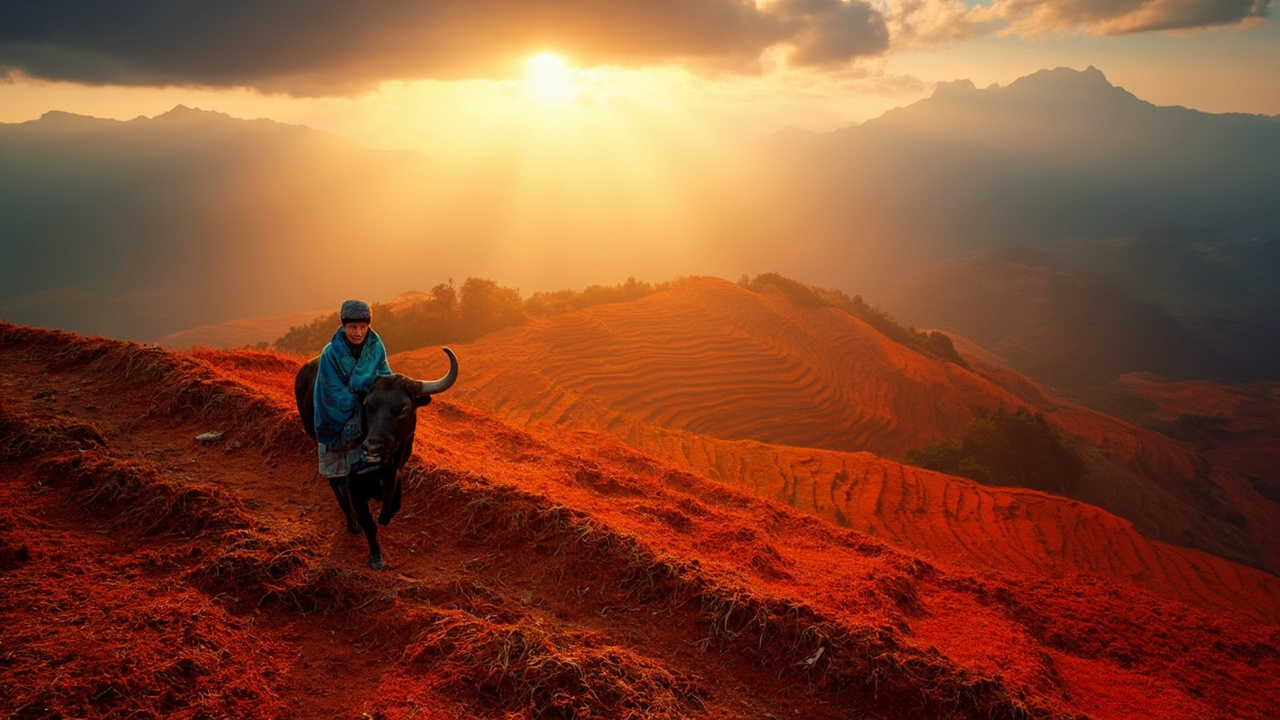
The rain came down in sheets, the kind of rain that turns the red dirt roads of Yunnan into a slick, orange-brown paste that sticks to your boots and makes every step a small negotiation with gravity. I was standing on a hillside above the village of Huakaishi, soaked through, watching the clouds tear apart to reveal a patch of terraced fields so violently red they looked Photoshopped. A farmer in a blue plastic poncho walked past me, leading a water buffalo, and didn’t even glance my way. He’d seen it all before. I hadn’t. That was seven years and about forty trips ago, and I still haven’t seen anything quite like it.
Dongchuan Red Soil is one of those places that photographs like a dream and can feel like a bit of a puzzle in person. It’s not a single scenic spot. It’s a scattered collection of hillside terraces, small villages, and working farmland spread across a high plateau about 150 kilometers northeast of Kunming. The red comes from iron oxide in the soil, and the patchwork of greens, yellows, and purples comes from the crops locals plant in rotation. It’s beautiful, but it’s also a real place where people live and farm. The sooner you understand that, the better your trip will be.
This guide covers everything I’ve learned from multiple visits: how to get there without losing your mind, where to actually stand for the good photos, what it costs, when to go, and the mistakes I’ve made so you don’t have to repeat them. I’ll also cover the practical China stuff that trips up first-time visitors, from WeChat Pay to VPNs.
Quick answer
Dongchuan Red Soil is a 2-4 day side trip from Kunming, best visited from November to April when the red earth is most exposed and the light is clearest. The two main viewing areas are Luoxiagou and Huakaishi, both reachable by bus or private driver from Kunming’s North Bus Station. Budget roughly $40-60 (CNY 290-430) per day for transport, lodging, and food. No entry fee for the main viewpoints, though a few small parking or scenic fees of $1-2 (CNY 7-14) may apply. Most international visitors can enter China visa-free for up to 30 days through the 2024-2025 visa-free policy extension, which continues into 2026.
The Short Version
If you only have 90 seconds, here it is: Dongchuan is not a national park with gates and ticket booths. It’s a farming region you drive through, stopping at pullouts and hilltops. The two must-see spots are Luoxiagou for the classic layered terraces and Huakaishi for the sweeping valley views. Go at sunrise or late afternoon. Skip it if you’re not into landscape photography or long drives on winding roads. It’s remote, the food is basic, and the English is almost nonexistent. But if you’ve seen a thousand photos of those red hills and want to stand in one, this is the place.
How I Picked These
I’ve been to Dongchuan five times since 2019, in every season except deep winter. I’ve hired private drivers, taken the public bus, and once hitched a ride with a local mushroom farmer who was going my way. I’ve stayed in the guesthouses run by the photography cooperatives in Luoxiagou and the smaller family homes in Huakaishi. I’ve talked to the farmers who work these fields, the drivers who shuttle tourists up the mountain, and the retired Chinese photographers who come back every year like migratory birds. The recommendations below come from those conversations and from standing in the rain, the fog, and the occasional glorious sunshine, waiting for the light to do its thing.
Comparison Table
| Rank | Place | Best For | Approx Cost (USD) | Time Needed | When to Go |
|---|---|---|---|---|---|
| 1 | Luoxiagou | Classic layered terrace views | $0 entry, $15-25 (CNY 110-180) lodging | 1-2 nights | Nov-Apr, sunrise |
| 2 | Huakaishi | Wide valley panoramas, sunset | $0 entry | Half day | Year-round, late afternoon |
| 3 | Dayutang | Quiet, less crowded terraces | $0 entry | 2-3 hours | Morning |
| 4 | Jinxiu Garden | Manicured viewpoint, easy access | $1 (CNY 7) parking | 1-2 hours | Midday for flat light |
| 5 | Luohan Shan | High elevation, cloud inversions | $0 entry | Half day | Nov-Feb, after rain |
| 6 | Qipanshan | Rolling hills, fewer tourists | $0 entry | 2-3 hours | Late afternoon |
| 7 | Wofo Village | Traditional village life | $0 entry | 1-2 hours | Morning |
| 8 | Lezhuang | Red soil + green crops contrast | $0 entry | 2 hours | Sep-Oct |
| 9 | Xiaocaidi | Sunset viewpoint, local food stalls | $0 entry | 1-2 hours | Sunset |
| 10 | The Drive Itself | The journey, not the destination | $30-50 (CNY 220-360) for private car | 3-4 hours each way | Any clear day |
Luoxiagou - Where the Postcards Come From
The first time I saw Luoxiagou in person, I actually laughed out loud. It looked exactly like the photos, which almost never happens. The terraces drop away from the road in a series of sweeping curves, each one a different shade of rust, ochre, and deep crimson, with strips of green wheat and yellow rapeseed cutting across. It’s the classic Dongchuan view, the one you’ve seen on every China travel blog and Instagram feed.
The village itself is small, maybe a hundred houses, most of them converted into guesthouses for photographers. The cooperative that runs the lodging has done a decent job keeping things simple and clean. You’ll eat the same stir-fried vegetables and rice at every meal, but the breakfast noodles with a fried egg on top are genuinely good.
Location: Luoxiagou Village, Dongchuan District, Kunming Prefecture Entry fee: Free for the main viewpoints. Some small parking areas charge $1 (CNY 7). Opening hours: 24/7. The viewpoint platforms are always open. How to get there: From Kunming North Bus Station (北部汽车客运站), take the bus to Dongchuan town (about 3 hours, $8-10 / CNY 60-70). From Dongchuan, take a local minibus or taxi to Luoxiagou (about 1 hour, $15-20 / CNY 110-140). A private car from Kunming direct is $50-70 (CNY 360-500) and takes about 3.5 hours. When to visit: November to April for the clearest skies. Sunrise is the money shot. Be on the platform by 7am in winter, 6:30am in summer. Insider tips: The best viewpoint is the one near the “Luoxiagou” signpost, about 500 meters past the village entrance. Go a bit further to the small hill on the left for a higher angle. The guesthouses all have rooftop platforms, which are great for sunset. Bring cash, the ATM in the village is unreliable. The local farmers will sometimes charge $1-2 (CNY 7-14) to let you walk into their fields for a closer shot, worth it if the light is good.
I met an old farmer named Yang who had been tilling these terraces for forty years. He told me the red soil is both a blessing and a curse, rich in minerals but prone to erosion. He shrugged when I asked if he liked the tourists. “They bring money,” he said, “and they leave footprints.”
Huakaishi - The Big Valley View
Huakaishi is the other big name in Dongchuan, and it’s a completely different experience from Luoxiagou. Instead of looking down at terraces, you stand on a ridge and look across a wide valley filled with red fields, small villages, and, on clear days, the distant mountains of the Jiaozi Snow Range. It feels more expansive, more like a landscape painting than a photograph.
The viewing area is basically a wide spot in the road with a few stone platforms built into the hillside. There’s a small cluster of food stalls selling grilled corn, roasted sweet potatoes, and the local specialty, a kind of fried potato cake that’s greasy and delicious. The sunset here is the main event, and people start gathering about an hour before.
Location: Huakaishi Village, about 20 minutes drive from Luoxiagou Entry fee: Free Opening hours: Always open How to get there: If you’re staying in Luoxiagou, it’s a $10-15 (CNY 70-110) taxi ride. If you have a private driver, they’ll know the way. The road is paved but winding, and in fog it can be slow going. When to visit: Late afternoon for sunset. Arrive by 5pm in winter, 6pm in summer. Weekdays are much quieter than weekends, when Kunming day-trippers flood in. Insider tips: The best spot is the second platform, not the first one everyone stops at. Walk past the food stalls and you’ll find it. Bring a jacket, even in summer, the wind up here is cold. The grilled corn is worth trying, it’s roasted over charcoal and brushed with chili salt. If you’re into photography, bring a telephoto lens, the valley is wide and you’ll want to compress the layers.
I once watched a Chinese tour group of about forty retirees set up their tripods in perfect formation, like a small army of photographers. They were all shooting the same view, and they all got the same shot. I found a spot slightly lower and to the left, and got a better angle with a farmer’s house in the foreground. Sometimes being a contrarian pays off.
Dayutang - The Quiet One
Dayutang is the place I send people who want the Dongchuan experience without the crowds. It’s a smaller set of terraces about fifteen minutes past Luoxiagou, and it gets maybe a tenth of the visitors. The views are less dramatic, but they’re more intimate, with the terraces curving around a small valley that feels almost private.
The village here is even smaller than Luoxiagou, just a handful of houses and one guesthouse that I’ve stayed at twice. The owner, a woman named Chen, runs the place with her husband and makes a mean hotpot from locally grown vegetables and pork. She doesn’t speak a word of English, but she’ll feed you until you can’t move and then insist you take some of her homemade chili paste with you.
Location: Dayutang Village, about 15 minutes drive from Luoxiagou Entry fee: Free Opening hours: Always open How to get there: From Luoxiagou, it’s a $5-8 (CNY 35-55) taxi ride. The road is a bit rough in places but passable in any car. When to visit: Morning light is best here. The terraces face east, so you get the sun rising directly over the fields. Go on a weekday if you can. Insider tips: The guesthouse can arrange a local guide for about $10 (CNY 70) who will take you to the lesser-known viewpoints. Ask for the spot near the old well, it’s not on any map. The terraces here are still actively farmed, so be respectful of the crops. The winter wheat is planted in November and harvested in April, so the green stripes are best in February and March. Bring small bills, the village shop doesn’t have change for large notes.
I made the mistake of arriving at Dayutang in full fog once, unable to see more than ten meters ahead. I was about to leave when Chen insisted I stay for lunch. By the time I finished my noodles, the fog had lifted and the valley was glowing. She just smiled and said, “Yunnan weather,” as if that explained everything. It kind of did.
Jinxiu Garden - The Easy View
Jinxiu Garden is the most developed viewpoint in Dongchuan, with paved paths, railings, and a proper parking lot. It’s also the most touristy, with souvenir stalls and a constant stream of tour buses. If you’re short on time or mobility, this is your spot. If you’re looking for a raw, untouched experience, skip it.
The name translates to “Brocade Garden,” which gives you a sense of the visual effect. The terraces here are laid out in a particularly intricate pattern, with the red soil and green crops creating a patchwork that does look like woven fabric. The viewing platforms are well-positioned, and you can get good shots without having to scramble up any hills.
Location: About 10 minutes drive from Luoxiagou, on the main road Entry fee: Free, but parking costs $1 (CNY 7) Opening hours: Dawn to dusk How to get there: Any taxi or private driver in the area knows the way. It’s on the main route between Luoxiagou and Huakaishi. When to visit: Midday is actually fine here, because the flat light reduces the contrast and makes the colors more even. If you want the classic look, come in the late afternoon when the low sun rakes across the terraces. Insider tips: The best photos are from the upper platform, which requires climbing about fifty steps. Most tour groups don’t bother, so you’ll have it mostly to yourself. The souvenir stalls sell decent quality local honey and dried mushrooms, good for gifts. There’s a small restaurant at the entrance that does a surprisingly good fried rice with local ham.
A tour guide I met here told me that the terraces were originally built in the 1950s as part of a government program to increase arable land. The farmers who built them had no idea they’d become a tourist attraction sixty years later. “They just wanted to grow potatoes,” he said, laughing.
Luohan Shan - For Cloud Chasers
Luohan Shan, or Arhat Mountain, is the highest point in the Dongchuan area, topping out at around 2,800 meters. It’s not the most scenic spot in clear weather, but when the conditions are right, it offers something the lower viewpoints can’t: cloud inversions. On winter mornings after rain, the valley below fills with a sea of white clouds, and the red terraces poke through like islands.
Getting there requires a bit of effort. The road up is steep and unpaved in places, and you’ll need a driver who knows the route. I’ve done it twice, once in glorious conditions and once in a whiteout where I couldn’t see my hand in front of my face. Both times were memorable, but only one produced photos.
Location: About 30 minutes drive from Luoxiagou, up a winding mountain road Entry fee: Free Opening hours: Always open, but the road can be impassable after heavy rain or snow How to get there: You’ll need a private driver or a very confident taxi driver. Agree on a price before you go, expect to pay $20-30 (CNY 140-220) for the round trip from Luoxiagou. When to visit: November to February, early morning. Check the weather forecast and go the morning after rain or snow. The cloud inversions are most common in winter. Insider tips: Bring warm clothes, it can be near freezing up here even in spring. The summit has a small Buddhist shrine that’s worth a look. If the clouds are too thick, wait an hour, they often clear by mid-morning. The road has a few hairpin turns that are tricky in wet conditions, make sure your driver is experienced.
I sat up here for two hours one morning, watching the clouds churn below me. A monk from the shrine came out and offered me a cup of tea. We didn’t exchange more than a few words, my Mandarin is terrible and his English was nonexistent, but we shared the silence and the view. It was one of the most peaceful mornings I’ve had in China.
Qipanshan - The Rolling Hills
Qipanshan, named for its resemblance to a chessboard, is a lesser-known area about twenty minutes from Luoxiagou in the opposite direction from Huakaishi. The terrain here is different, less steep and more rolling, with the red fields spreading across gentle slopes rather than dramatic terraces. It’s a good spot for wide-angle shots and for understanding the scale of the region.
The main viewpoint is a small hill with a flat top that you can climb in about ten minutes. From the top, you can see the fields stretching in every direction, with small villages scattered among them. It’s a quieter, more contemplative experience than the main viewpoints.
Location: About 20 minutes drive from Luoxiagou, towards the town of Ayi Entry fee: Free Opening hours: Always open How to get there: A taxi from Luoxiagou will cost $10-15 (CNY 70-110). The road is paved but narrow in places. When to visit: Late afternoon for the golden light. The rolling hills catch the low sun beautifully, creating long shadows that emphasize the contours. Insider tips: The climb to the top is easy but there’s no shade, so bring water and a hat. The village at the base of the hill has a small shop that sells cold drinks and snacks. If you’re here in March, the rapeseed fields are in full bloom, adding bright yellow stripes to the landscape. The local farmers are used to photographers and will usually wave if you wave first.
I met a young couple from Guangzhou here who were on their honeymoon. They’d rented a car and were driving around Yunnan for two weeks, and Dongchuan was their third stop. They asked me for restaurant recommendations, and I sent them to the guesthouse in Dayutang. I hope they made it, Chen’s hotpot is worth the detour.
Wofo Village - A Slice of Real Life
Wofo Village is not a viewpoint at all. It’s a working village about ten minutes from Luoxiagou, and it’s worth a visit if you want to see how people actually live in this region. The village has a small temple, a few shops, and a primary school. The houses are built from the local red stone, which gives the whole place a warm, earthy glow in the afternoon light.
There’s no formal tourist infrastructure here, which is exactly the point. You can wander the narrow lanes, watch the farmers working in the fields, and maybe buy some vegetables or eggs from a roadside stall. It’s a reminder that Dongchuan is not just a photo opportunity, it’s a place where people live and work.
Location: About 10 minutes drive from Luoxiagou Entry fee: Free Opening hours: Always open, but the village is most active in the morning How to get there: A short taxi ride from Luoxiagou, or a 30-minute walk if you’re feeling energetic. The road is flat and easy. When to visit: Morning, when the farmers are heading out to the fields and the village is waking up. The light is also good for photos of the red stone houses. Insider tips: The temple at the center of the village is worth a look, it’s small but beautifully maintained. If you see a stall selling fresh eggs, buy some, they’re from free-range chickens and taste completely different from supermarket eggs. The village school lets out around 4pm, and the kids are always curious about foreigners. A few words of Mandarin go a long way here. Don’t take photos of people without asking, especially the elderly.
I bought a bag of potatoes from an old woman here for about $1 (CNY 7). She insisted on giving me a handful of chili peppers as a bonus, and mimed that I should fry them with the potatoes. I did, and it was the best meal I had all trip.
Lezhuang - The Green Contrast
Lezhuang is a small area about halfway between Luoxiagou and Huakaishi, and it’s notable for having some of the most striking color contrasts in the region. The red soil here is particularly vivid, and the local farmers plant a lot of green vegetables, creating a bold patchwork effect that’s especially photogenic in the autumn months.
The main viewpoint is a small platform off the main road, easy to miss if you’re not looking for it. There’s a signpost in Chinese, so look for the characters 乐庄. The view looks down over a series of terraces that curve around a small stream, with the red fields rising on both sides.
Location: Between Luoxiagou and Huakaishi, on the main road Entry fee: Free Opening hours: Always open How to get there: If you’re driving between the two main viewpoints, you’ll pass right by it. There’s a small pullout where you can park. When to visit: September and October, when the summer crops are being harvested and the fields are a mix of red, green, and gold. Late afternoon light is best. Insider tips: The best angle is from the small bridge over the stream, not from the platform. The bridge gives you a lower perspective that makes the terraces look taller. The stream is clean enough to wade in on hot days, but watch out for slippery rocks. There’s a farmer nearby who sells fresh-picked vegetables from a cart, the cucumbers are excellent.
I stopped here on a whim during a drive between the main viewpoints and ended up staying for an hour. A farmer named Li was harvesting his cabbage crop and offered me one, fresh from the ground. I ate it like an apple, dirt and all. It was the sweetest cabbage I’ve ever had.
Xiaocaidi - Sunset and Street Food
Xiaocaidi is a small village that’s become popular for sunset viewing, mostly because it has a wide, open viewpoint that can accommodate a lot of people. It’s not the most dramatic spot in Dongchuan, but it’s the most social. On clear evenings, you’ll find a crowd of photographers and day-trippers gathered here, along with a row of food stalls that set up shop in the late afternoon.
The food is the real draw for me. The stalls sell grilled skewers, fried dough sticks, and a local specialty called “red soil potatoes” that are grown in the iron-rich earth and have a distinctive flavor. They’re boiled, then fried with chili and herbs, and they’re absolutely delicious.
Location: About 15 minutes from Luoxiagou, on the road to Huakaishi Entry fee: Free Opening hours: The viewpoint is always open, but the food stalls operate from about 3pm to 8pm How to get there: A taxi from Luoxiagou will cost $5-8 (CNY 35-55). It’s also a pleasant walk if you have the time, about 45 minutes. When to visit: Late afternoon for sunset. Get there by 5pm to secure a good spot and to have time to eat before the light show starts. Insider tips: The red soil potatoes are a must-try, they’re unique to this region. The stall at the far end of the row, run by an old couple, is the best. Bring small bills for the food stalls, they don’t take cards or mobile payments. If the sunset is a bust, which happens, the food is still worth the trip. The viewpoint faces west, so you get a clear view of the sun dropping behind the distant mountains.
I was here one evening when a group of Chinese college students started singing folk songs while waiting for the sunset. It wasn’t a performance, they were just having fun. By the time the sun went down, half the crowd was singing along. It was one of those moments that reminds you why you travel.
The Drive Itself - Don’t Miss This
Here’s the thing nobody tells you about Dongchuan: the drive from Kunming is part of the experience. The road climbs from the Kunming basin, which sits at about 1,900 meters, up to the Dongchuan plateau at around 2,500 meters. Along the way, you pass through dramatic river valleys, pine forests, and small towns that feel frozen in time.
The last stretch, from the town of Ayi to Luoxiagou, is particularly beautiful. The road winds along the edge of a deep valley, with the red fields appearing in patches as you climb. On clear days, you can see for miles. On foggy days, it’s an atmospheric drive through a white world.
Location: The road from Kunming to Dongchuan, via the G85 expressway and the provincial roads Entry fee: N/A Opening hours: The road is always open, but it can be slow in fog or rain How to get there: You can drive it yourself if you’re comfortable with Chinese road conditions, or hire a driver. The public bus from Kunming North Station to Dongchuan town takes the same route but stops frequently. When to visit: Any time of year, but the light is best in the late afternoon when the sun is low and the red soil glows. Insider tips: If you’re driving yourself, fill up in Kunming before you leave, gas stations are sparse once you’re in the mountains. The roadside stalls near Ayi sell excellent dried mushrooms and local honey. Take the old road, not the expressway, for the last stretch, it’s slower but much more scenic. If you get car sick, take motion sickness medicine before you start, the winding roads are no joke.
My first time driving this road, I had to pull over twice to let my stomach settle. The second time, I was with a driver who knew every curve and took them at speed, and I was fine. Lesson learned: the journey is part of the adventure, but it’s also a physical challenge.
FAQ summary
Dongchuan Red Soil is a free-to-visit farming region near Kunming, best reached by private car or bus from Kunming’s North Bus Station. The main viewpoints are Luoxiagou and Huakaishi, with the best light at sunrise and sunset from November to April. Budget about $40-60 (CNY 290-430) per day for a comfortable visit, and note that English is rarely spoken, so download a translation app before you go. The area is accessible year-round, but winter offers the clearest skies and most dramatic red soil exposure.
FAQ
Q: Do I need a visa to visit Dongchuan Red Soil in 2026? A: Most international visitors can enter China visa-free for up to 30 days under the current policy, which has been extended through 2026. Check with the Chinese embassy in your country before booking, as the policy can change. For longer stays or multiple entries, a standard L tourist visa costs about $140 (CNY 1,000) and takes 4-5 working days to process.
Q: How do I get from Kunming to Dongchuan Red Soil? A: The most convenient option is a private car, which costs $50-70 (CNY 360-500) and takes about 3.5 hours. The budget option is a bus from Kunming North Bus Station to Dongchuan town ($8-10 / CNY 60-70, 3 hours), then a local minibus or taxi to Luoxiagou ($15-20 / CNY 110-140, 1 hour). Book the private car through your hotel or a local travel agency.
Q: What is the best time of year to visit Dongchuan Red Soil? A: November to April is the best window, when the skies are clearest and the red soil is most exposed. The terraces are most colorful in February and March, when the winter wheat adds green stripes to the red fields. Summer is rainy and foggy, and the soil is often covered by crops.
Q: Do I need to book accommodation in advance? A: Yes, especially from November to April and on weekends. The guesthouses in Luoxiagou and Dayutang are small and fill up fast. Book at least a week in advance through a Chinese app like Ctrip, or ask your Kunming hotel to arrange it. Prices range from $15-25 (CNY 110-180) per night for a simple room.
Q: Is English spoken in Dongchuan? A: Almost none. The guesthouse owners, taxi drivers, and shopkeepers all speak only Chinese. Download a translation app like Pleco or Google Translate (with the Chinese language pack downloaded for offline use) before you go. Learn a few basic phrases like “thank you” (xièxie) and “how much” (duōshǎo qián), it goes a long way.
Q: Do I need cash or will mobile payments work? A: WeChat Pay and Alipay work everywhere in Dongchuan, but you’ll need a Chinese bank card or a foreign card linked to the apps, which can be complicated to set up. Bring cash as a backup, especially for small purchases at food stalls and village shops. ATMs in the area are unreliable, so withdraw enough in Kunming before you go.
Q: Do I need a VPN for my phone in China? A: Yes, if you want to use Google, WhatsApp, Instagram, or any Western social media and services. China blocks these, so download a reliable VPN and test it before you arrive. You can buy a Chinese SIM card at the airport or use an eSIM from providers like Holafly that include VPN functionality.
The Honest Wrap-up
Dongchuan Red Soil is not for everyone. If you want polished viewpoints, English-speaking guides, and gourmet food, this isn’t the place. It’s for travelers who are willing to put up with rough roads, basic guesthouses, and a lot of waiting around for the light to cooperate. But if you’re willing to do that, you’ll be rewarded with one of the most unique landscapes in China, a place that looks like it was painted by someone who didn’t believe in subtlety.
My advice to a friend: go in winter, stay at least two nights, and don’t try to see everything. Pick one or two viewpoints and really spend time there. Watch the light change. Talk to a farmer if you can. Eat the potatoes. And bring a good jacket, because the wind up here doesn’t care about your plans.
More guides you may like
Top 10 Bridges in China: The Complete 2026 Guide
China's bridges are engineering marvels spanning mountains, rivers, and seas. Here are 10 of the most spectacular, from ancient stone to modern steel.
8 min read

Top 10 Buddhist Sites in China: The Complete 2026 Guide
From the Leshan Giant Buddha to the Dunhuang Caves, these 10 Buddhist sites represent 2,000 years of China's spiritual heritage.
9 min read
Top 10 Day Trips from Beijing You Shouldn't Miss: The Complete 2026 Guide
Beijing is packed with history, but some of China's best experiences are just a few hours away. Here are 10 day trips that will transform your visit.
9 min read
Top 10 Hidden Gems in China Off the Beaten Path: The Complete 2026 Guide
Beyond the Great Wall and Terracotta Warriors, China has incredible hidden destinations few tourists ever reach. Here are 10 underrated gems worth the detour.
9 min read
Top 10 Markets and Shopping Streets in China: The Complete 2026 Guide
From Shanghai's Bund to Beijing's Silk Street - 10 markets where foreigners can haggle, explore, and bring home authentic Chinese goods.
9 min read
Top 10 Museums in China You Shouldn't Miss: The Complete 2026 Guide
China's museums span 5,000 years of civilization. These 10 - from the Palace Museum to Xi'an's terracotta gallery - are unmissable for culture lovers.
9 min read